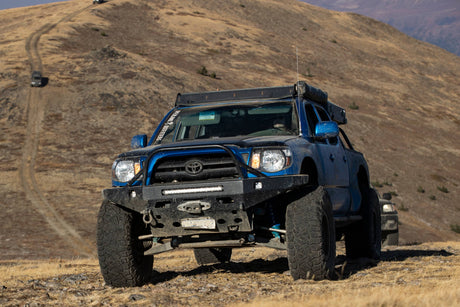

It happens fast. You pick a good line, stay reasonable on the throttle, and still end up with that sickening moment when something lets go. On late model Toyotas, two of the most common trail failures are a CV axle and a tie rod.
The good news is neither repair is especially complicated. The bad news is they are a whole lot less fun when you are in mud, rain, or lying on the ground in the middle of nowhere. Still, if you know the process ahead of time, half the battle is already won.
Here’s how to handle both repairs on the trail, what to watch out for, and what to do if you do not have a spare part with you.
Why CVs and Tie Rods Break on the Trail
Both failures usually come from binding and load.
A tie rod commonly gets damaged when the steering is at a bad angle and the suspension is loaded hard. That can bend the rod or snap it outright, especially while turning and pushing against an obstacle.
A CV axle often breaks when the front end starts hopping or bouncing during a climb. Once the wheel binds and unloads repeatedly, the joint can fail in a hurry.
Obviously, the best fix is not breaking parts in the first place. Smooth throttle, good wheel placement, and avoiding wheel hop go a long way. But when something does fail, knowing the repair process can get you moving again.
Trail Repair #1: Replacing a CV Axle
Step 1: Remove the wheel
This is the starting point for a CV repair. Once the wheel is off, you can access the axle nut, lower ball joint bracket, and the inner CV at the differential.
Step 2: Remove the dust cap
Tap off the small dust cap in the center of the hub. Behind it you’ll find:
- The end of the CV axle
- A locking collar
- A cotter pin
- The axle nut
On this Toyota setup, the axle nut is 35mm. That socket is one of the must-have items in a proper off-road tool kit.
If you do not have an impact on the trail, you will need a way to keep the hub from turning. The simplest options are:
- Have someone hold the brake pedal
- Use a pry bar through the wheel studs to keep the hub from rotating
Step 3: Remove the lower ball joint bracket bolts
There are two bolts underneath that hold the lower ball joint bracket in place. These are 19mm. Remove both so the knuckle can move enough to free the axle from the hub.
Step 4: Remove anything blocking access
If your skid plate blocks access to the CV or differential area, it needs to come off. On some trucks this is quick, on others it is just one more annoying step, but you need room to work.
Step 5: Pull the CV out of the hub
With the lower connection loose, pull the hub assembly outward and work the outer end of the CV axle free from the hub.
Two things matter here:
- Do not overextend the axle while pulling things apart. If you pull too far, you can separate the inner joint internals.
- Watch the brake line and nearby components so you do not create a second problem while fixing the first one.
It can be tight. In some cases, removing the sway bar link or even the brake caliper can create more room, but it is often possible to snake the axle out carefully without going that far.
You also want to be mindful of the seal at the back of the hub area and avoid beating on it.

Step 6: Decide whether you are installing a spare CV or just limping out
This is where trail repairs split into two options.
If you do not have a spare CV axle
You can still reassemble the truck and get out, depending on where the axle failed.
The key point is this: leave the inner stub in the differential.
If the CV has failed internally, especially at the inner joint, do not yank that stub out of the diff and leave the hole open. That invites dirt and contamination straight into the differential, which is the last thing you want.
Instead:
- Cut the clamp on the damaged CV boot
- Pull the axle assembly out of the inner joint
- Leave the inner stub seated in the differential
- Reassemble everything else enough to get moving again
It will be greasy and messy, but it protects the diff.
⚠️ Very important note for anyone without a spare CV axle
When doing the CV, without a spare, you MUST keep the outer stub in as well, because it holds the wheel bearing together. Without a spare, you are likely going to have to cut the axle right at the outer joint so it doesn't flail around and break things. The outer joint doesn't come apart easy like the inner. It is possible to get it apart without a grinder, but doesn't always work. To do that, you can use a chunk of pipe, slide it over the axle, and slam it on a rock or something, and it might pop the axle out past the internal c clip after many tries.
If you do have a spare CV axle
Then you need to remove the inner stub from the differential and install the replacement.
The inner CV is retained by a small clip. To pop it out, pry carefully against the solid lip of the inner housing or the reinforced notches on the cup. Do not pry against the seal area, because it bends easily and creates a bigger repair later.
Once the clip releases, the old axle comes out.
Where CV axles usually fail
Understanding the failure helps determine what to remove and what to leave alone.
- Inner joint failure: the most common. The joint can pop apart, break the star, or otherwise fail internally.
- Outer joint failure: less common, but possible.
- Axle shaft failure: the shaft itself can shear.
No matter which part fails, if you are trying to get off the trail without a spare, the same idea applies: keep the inner stub in place to protect the differential from contamination.
Reinstalling the CV axle
If you have a replacement axle, pop it into the differential until the clip seats, then guide the outer end back into the hub and reassemble the suspension components.
Once everything is back together, torque specs matter. If you cannot torque it precisely on the trail, at least come back and do it properly once you are home.
- Axle nut: 173 ft-lb
-
Lower ball joint bracket bolts: 118 ft-lb
Trail Repair #2: Replacing an Inner Tie Rod

The other common off-road steering failure is the tie rod, especially the inner tie rod. The outer can fail too, but the inner is the usual offender.
For demonstration purposes, it makes sense to cover both the outer and inner replacement process together.
Step 1: Disconnect the outer tie rod from the knuckle
Start by removing the cotter pin and the castle nut from the outer tie rod end.
On this setup the nut is 19mm, although that can vary if parts have been replaced before.
If the tapered stud is stubborn, one simple trail trick is to thread the castle nut back on loosely so you do not damage the threads, then strike the top to break it free.
If you are only changing the outer tie rod
You can stop almost here.
Before removing the outer tie rod from the inner, take a measurement or mark its position. You want a reference point so the replacement goes back on in nearly the same spot. That will not replace a proper alignment, but it will usually get you close enough to drive out.
If the inner tie rod is the damaged part, keep going.
Step 2: Remove the tie rod boot
There is a clamp at the back of the steering rack boot. Remove that clamp and slide the boot off to expose the inner tie rod.
Step 3: Straighten the locking washer tabs
The inner tie rod is secured with a washer that has bent tabs locking it in place. Tap or bend those tabs back so the tie rod can be removed.
Step 4: Remove the inner tie rod
There is a special shop tool for this, but on the trail most people are not carrying one.
This is where a pipe wrench earns its keep. It may not be a classic mechanic’s tool, but it is incredibly useful for off-road repairs. In many cases, it will remove the inner tie rod quickly and without much drama. Sometimes a large adjustable wrench can work too, but the pipe wrench is often the better choice.
Step 5: Install the replacement inner tie rod
When reinstalling, pay attention to the locking washer. It has tabs that need to align with the notches on the tie rod seat.
Once the new inner tie rod is installed, bend those tabs back over to lock it in place.
Step 6: Reinstall the boot
Slide the steering rack boot back into place and secure the clamps.
Properly clamping the inner side of the boot can be fiddly, especially on the trail. If you have the right clamp and tool, use them. If not, a temporary zip tie can get the job done until you can fix it correctly at home.
Step 7: Reinstall the outer tie rod
Thread the outer tie rod back on to the same measurement or position you recorded earlier. Again, this is only a trail-side approximation. You still need a real alignment afterward.
Then reconnect the outer tie rod end to the knuckle, tighten the nut, and install a new cotter pin.
At that point, the steering is back together and you are ready to move.
Trail Tips That Make These Repairs Easier
A few small details make a big difference when you are doing this in the dirt.
- Carry the right sockets, especially the 35mm axle nut socket for Toyota CV work.
- Pack a pipe wrench. It is incredibly useful for tie rod repairs and plenty of other trail jobs.
- Know your torque specs, even if final torquing has to wait until you get home.
- Protect seals and brake lines while pulling components apart.
- Have spare cotter pins and clamps, or at least a few zip ties for temporary fixes.
Bring spare parts if possible. A replacement CV or tie rod can be the difference between a quick repair and a long recovery.
When You Get Home
Trail fixes are exactly that: trail fixes.
Even if everything seems solid again, take the time to go back through the repair properly once you are home. Torque the fasteners to spec, inspect the seals and boots, and get an alignment done after any tie rod work.
That extra step is what turns a limp-out repair into a trustworthy repair.
Final Thoughts
Breaking parts off-road is never fun, but a broken CV axle or tie rod does not automatically mean the trip is over. These are two of the most common failures on the trail, and both can usually be handled with basic tools, a little patience, and a clear understanding of what needs to come apart.
It is definitely easier in a shop than in the mud, but the process is the same. If you know what to remove, what to leave alone, and how to put it back together well enough to get out safely, you are already ahead of the game.
Preparation is not just about carrying tools. It is also about knowing how to use them when things go sideways.